Choosing a TV mount looks simple until you’re standing in the store aisle looking at twenty boxes. Almost all of them fall into three types: fixed, tilting and full-motion. The right one depends on where you sit, where the light comes from, what the wall is made of and how often you want to move the screen.
Quick answer: which TV mount should I get?
Get a fixed mount if you watch straight on and want the slimmest look. Get a tilting mount if the TV sits higher than eye level or faces a window. Get a full-motion mount if you watch from more than one spot, such as a sofa and a kitchen. Above tall fireplaces, a pull-down mount is the most comfortable.
- Check the mount’s VESA pattern and weight rating against your TV
- Full-motion mounts need two studs or solid masonry
The three main mount types compared
| Feature | Fixed | Tilting | Full-motion |
|---|---|---|---|
| Gap from wall | About 1 to 1.5 in | About 2 to 3 in | About 3 in folded |
| Movement | None | Tilts down (and sometimes up) | Tilts, swivels and pulls out |
| Best rooms | Living rooms, media walls | Bedrooms, higher positions | Open-concept rooms, corners, kitchens |
| Look | Slimmest, like a picture | Slim | Slightly thicker when folded |
| Wall needs | Studs or masonry | Studs or masonry | Two studs or solid masonry |
| Cable access | Harder; plan cables first | Easier when tilted | Easiest; pull the TV out |
Fixed mounts: the cleanest look
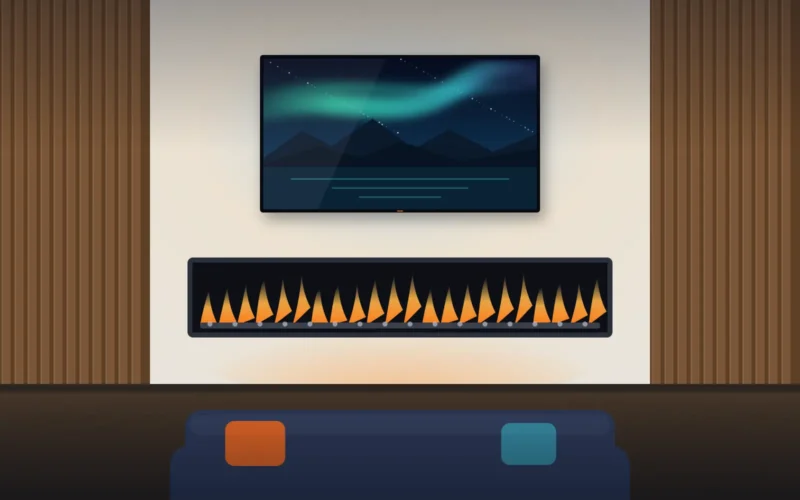
A fixed (low-profile) mount holds the TV about an inch from the wall. It’s the most stable and the cleanest-looking option, and it’s ideal when your seating faces the TV directly and the screen sits close to eye level.
The trade-off is access. Once the TV is up, reaching the ports is awkward, so it pays to connect and route every cable before hanging the screen. That’s also why fixed mounts pair well with in-wall wire concealment.
Choose fixed if: you watch from one sofa, the TV is at eye level, and you want it to look built in.
Tilting mounts: fixing height and glare
A tilting mount lets you angle the screen down, usually 5 to 15 degrees. That makes a big difference when the TV has to sit higher than eye level, such as in a bedroom where you watch reclined, or above a dresser. Tilting also helps cut glare from windows and ceiling lights.
Choose tilting if: the TV will be above eye level, or the room gets reflections on the screen.
Full-motion mounts: flexibility for open rooms
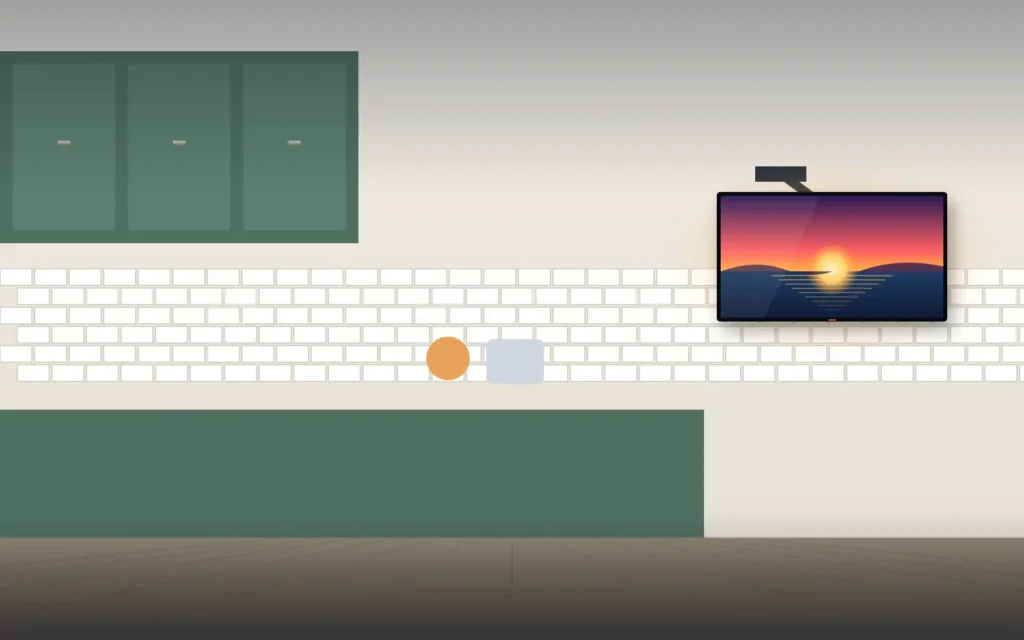
A full-motion (articulating) mount has an arm that extends, swivels and tilts. You can pull the TV out from the wall and angle it toward the kitchen, the dining table or a second seating area, then push it back flat.
Because the arm creates leverage, full-motion mounts put much more force on the wall. They should be anchored into two studs, steel-stud backing designed for the load, or solid masonry. A full-motion arm in drywall alone is the kind of install that fails.
Choose full-motion if: you watch from more than one place, the TV is in a corner, or you need regular access to the back.
Other mounts worth knowing
Pull-down (mantel) mounts
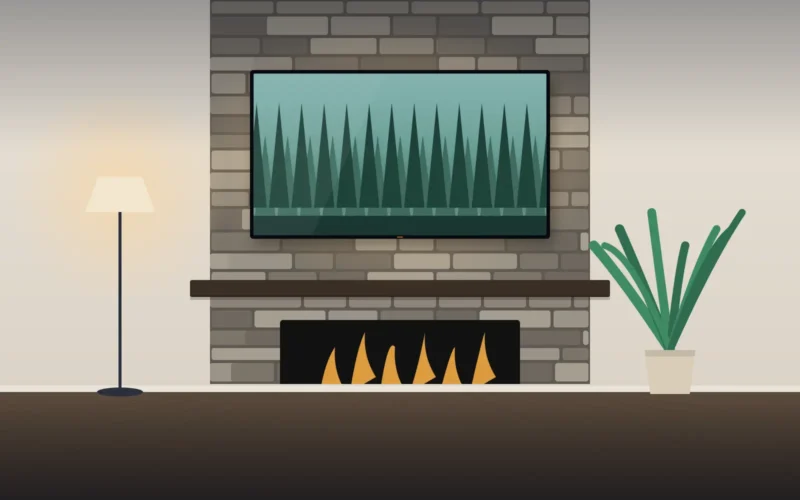
Designed for TVs above fireplaces. The TV lowers to eye level when you watch and lifts back above the mantel afterwards. They’re the best fix for a tall mantel. See fireplace TV mounting.
Ceiling mounts
A pole drops from the ceiling joists. Common in bars, gyms and retail. In condos, many ceilings are post-tensioned concrete and can’t be drilled without approval.
Flush art-TV mounts
Frame-style TVs use their own dedicated slim mounts to hang flush like a picture.
Check these before you buy
- VESA pattern. The hole spacing on the back of your TV (for example 300 x 300 or 400 x 400) must match the mount.
- Weight rating. Pick a mount rated comfortably above your TV’s weight, especially for full-motion arms.
- Wall type. Drywall on wood studs, steel studs, brick and concrete all need different anchors. See walls we mount on.
- Stud spacing. Wider TVs and full-motion mounts need a wall plate that reaches two studs.
- Outlet and device location. Plan where the cables will go before the TV goes up.
TV mount FAQs
Which TV mount is best for a living room?
A fixed mount for the cleanest look when you watch straight on, or a tilting mount if the TV sits slightly high. Open-concept rooms often suit full-motion.
Are full-motion mounts safe?
Yes, when they’re anchored into two studs or solid masonry and rated for your TV. The risk comes from installing them into drywall alone.
Can a tilting mount fix a TV that’s too high?
It helps by angling the screen toward you and reducing glare, but it doesn’t lower the screen. For tall fireplaces, a pull-down mount is better.
Do you supply TV mounts?
Yes. We can bring a fixed, tilting, full-motion or pull-down mount matched to your TV and room, or install the one you already have.
Get the right mount, installed properly
Not sure which mount suits your room? Send us a photo of the wall and your TV model on WhatsApp, and we’ll recommend one and give you a free quote. We install every mount type across Hamilton, Burlington, Oakville, Mississauga, Toronto and nearby. Book TV wall mounting.