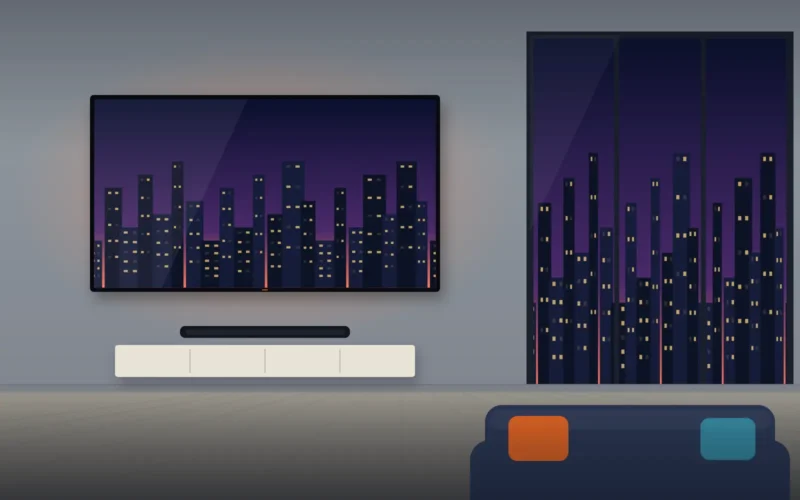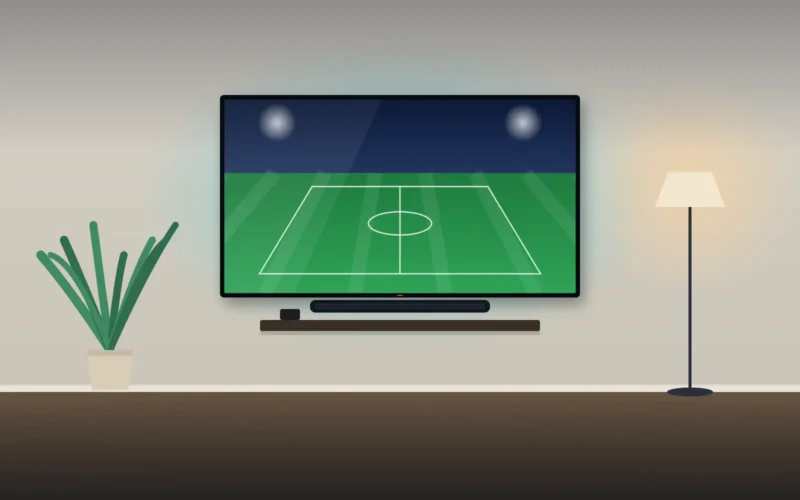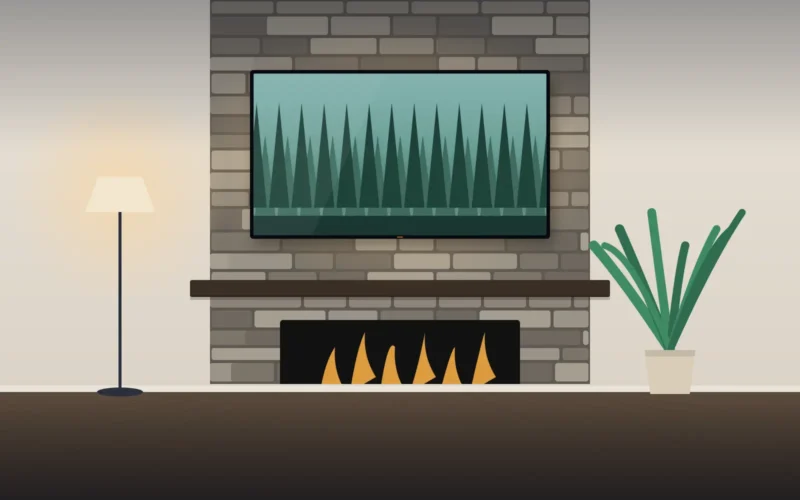
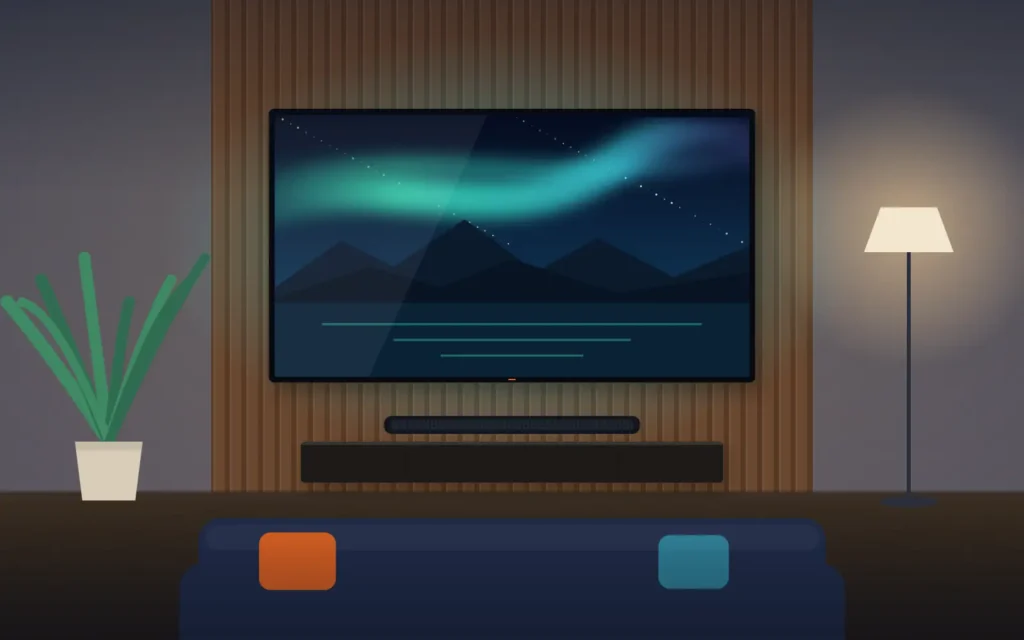
The most common TV mounting mistake isn’t a TV falling off the wall. It’s a TV mounted too high. It looks fine when you stand back to admire it, then gives everyone a sore neck by the second episode. Here’s how installers decide the right height, room by room.
The short answer
For most living rooms, mount the TV so the centre of the screen sits at about seated eye level. For a typical sofa, that’s roughly 40 to 45 inches (100 to 115 cm) from the floor to the centre of the screen.
To find your own number, sit where you normally watch, look straight ahead, and have someone measure from the floor to your eye level. That measurement is your target for the centre of the screen.
Why the centre of the screen matters
Many people measure to the bottom of the TV, which is why so many end up too high. Because bigger TVs are taller, mounting a 75″ TV with its bottom edge at the same height as a 50″ TV pushes the centre of the screen up several inches. Always plan from the centre.
A quick way to find the bracket position:
- Decide the height for the centre of the screen.
- Measure from the centre of your TV to the mounting holes on the back.
- Add or subtract that distance to find where the wall bracket goes.
Most mounts also let you shift the TV up or down a little after it’s hung, which helps with fine-tuning.
Living room
Use the eye-level rule. If your sofa is deep or low, the right height may be closer to 38 inches; with tall or upright seating it may be closer to 46. As a rough guide for screen size, many people enjoy a TV whose diagonal is about half to two-thirds of the distance between their eyes and the screen. Sitting about 9 feet away, that’s somewhere around a 55″ to 75″ TV.
Bedroom
In a bedroom you’re usually reclined or propped up on pillows, so your eye level is higher and angled up. Mounting a little higher than in the living room is fine here, often with the centre of the screen around 50 to 60 inches from the floor. A tilting mount that angles the screen down slightly makes a big difference to comfort and reduces glare from lamps.
Above a fireplace
The fireplace wall is where height goes wrong most often, because the mantel forces the TV well above eye level. There are three ways to make it comfortable:
- Mount as low as the mantel safely allows.
- Use a tilting mount to angle the screen down toward your seating.
- Use a pull-down mantel mount, which lowers the TV to eye level when you watch and lifts it back up afterwards.
Before mounting over any fireplace, check the heat above the mantel. Our guide to mounting a TV above a fireplace covers this in detail.
Basements and media rooms
Basement ceilings are often lower, and seating is sometimes tiered. Measure from the main row of seats. With a second, raised row, set the height for the front row and the back row will still see clearly over it. For projectors, the bottom of the screen is usually about 24 to 36 inches from the floor, depending on the room.
Open-concept rooms
If you watch from both the sofa and the kitchen island, set the height for the sofa, which is where you spend the longest watching. A full-motion mount then lets you swing the screen toward the kitchen when you’re cooking.
Kids, pets and safety
Height is also about safety. In homes with young children, mount the TV so the bottom edge is above toddler reach and keep cables concealed so nothing can be pulled. Always mount into studs, steel-stud backing or masonry with anchors rated for your TV’s weight.
Try it before you drill
The easiest trick: cut a piece of cardboard the size of your TV (or tape out the outline on the wall with painter’s tape) and live with it for a day. Sit, recline and watch from different spots. If it feels too high, it is.
When we install, we do exactly this. We measure from your seating, show you the outline on the wall and only drill once you’re happy with it.
Want it done for you?
Our installers mount TVs across Hamilton and the GTA every day, on drywall, brick, stone and concrete, at the height that suits your room. Get a free quote or WhatsApp a photo of your wall.